Home / Websites by industry / Physiotherapists

Websites for physiotherapists

A website for your physio clinic, live in one business day

Patients looking for a physio want to know what you treat, what it costs and how to book before they pick up the phone. We design, write and launch a one-page clinic website that answers those questions in 1 business day for a one-time US$235, and you can click through the live demo for a fictional clinic below.

See your site first. Pay only when you approve the preview — one free preview per business. Pay by card, PayNow or bank transfer after approval.

US$235ONE-TIME
1 dayDELIVERY
YoursDOMAIN IN YOUR NAME
FreePREVIEW FIRST

Live demo

What your physiotherapist website could look like.

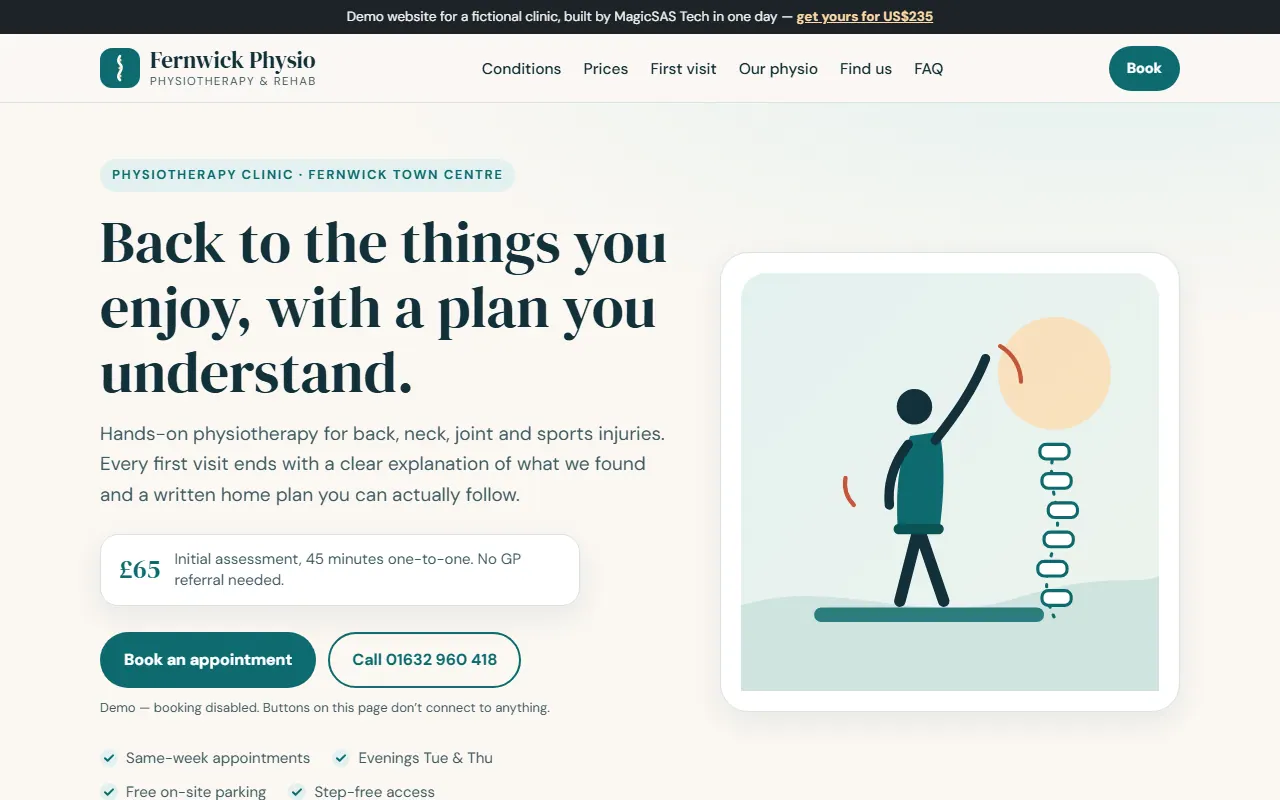
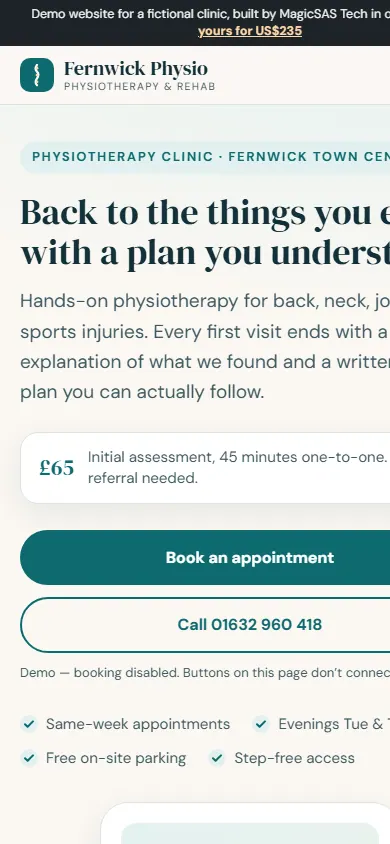
We built a one-page site for Fernwick Physio, a fictional physiotherapist business, the same way we'd build yours: one day, written and designed for the trade. Open the live demo on your phone.

  1. Conditions treated, up front Patients search by problem, such as knee pain or a sore back, not by technique. Listing what you help with in plain words tells them in seconds that they have found the right clinic.
  2. Prices and session lengths, visible Self-paying patients often compare clinics on cost before they call. Showing the initial assessment and follow-up prices, plus your cancellation policy, answers the most common phone question for you.
  3. Registration shown, reviews handled carefully The practitioner card shows where a real registration number goes, so patients can check it. The sample review sticks to booking, parking and communication, which matters in places like Australia where clinical testimonials are not allowed.
  4. Booking, hours and access in one place Every booking button points to one spot that would link to your existing booking system. Hours, parking and step-free access are right beside it, because people in pain want to know how easy the visit will be before they travel.

The demo business, its people, prices and reviews are fictional and labelled as such. Your site uses your real details, photos and prices.

What it has to do

Five jobs a physiotherapist website must do well.

Say what you treat, in patients' words

Someone with a rolled ankle or a stiff neck should see their problem named within a few seconds. A short list of conditions with one plain line each does more than a paragraph about your treatment philosophy. It also gives search engines the words people actually type.

Make booking one tap

Most physio clinics already take online bookings through practice software such as Cliniko, Jane or WriteUpp. The website's job is to send people straight to that booking page, or to a call or WhatsApp button, from every section. It should not collect symptoms or health details itself.

Be clear about prices, insurance and referrals

Show what an initial assessment and a follow-up cost, how long each lasts, and your cancellation policy. Say whether patients need a doctor's referral and whether you bill insurers directly or provide receipts for claims. Clear answers here cut down on calls and no-shows.

Build trust without breaking advertising rules

Qualifications, registration numbers, experience and a friendly bio do the heavy lifting. Avoid promising cures or set outcomes, and check your local rules before using patient reviews. A calm, specific page reads as more professional than one full of superlatives.

Help local patients find and reach you

Your clinic name, address, phone number and hours should match your Google Business Profile exactly. Add parking, public transport and accessibility details, since many patients arrive with limited mobility. The page must load quickly and read well on a phone, where most local searches happen.

Your options

Builder, agency, or done for you in a day.

Ways for a physiotherapist to get a website, compared
 DIY builderMagic Dev Studio one-page siteWeb agency
CostAbout US$140–230 a year, every yearUS$235 once + about US$20–60/yr domain and hostingTypically US$600–2,300+ for a small site
Who writes itYouWe do, for physiotherapistsUsually you supply the text
Time to liveYour evenings and weekends1 business day2–8 weeks
Pay before you see it?Subscription firstNo — preview first, pay on approvalUsually a deposit
PagesAs many as you buildOne scrolling page (more quoted separately)Several

Builder prices from our 2026 builder comparison (cheapest custom-domain plans, billed yearly). Agency figures are typical published small-site prices, not a quote.

Before you publish

Things physiotherapists should know.

UK: "physiotherapist" is a protected title

In the UK, "physiotherapist" and "physical therapist" are protected titles, and only people on the Health and Care Professions Council (HCPC) Register may use them. The HCPC looks into cases where someone uses a protected title without being registered. If your site lists several practitioners, check that everyone described as a physio is registered, and consider showing registration numbers so patients can look them up. Other countries have their own regulators and title rules.

Source: HCPC: The professions we regulate (protected titles)

Australia: no clinical testimonials in advertising

Physiotherapy is a regulated health profession in Australia, and Ahpra says the National Law does not allow testimonials to be used to advertise regulated health services. Comments about clinical aspects, such as symptoms, diagnosis, treatment or outcomes, cannot be used. Comments only about customer service, such as booking, parking or friendly staff, are not treated as testimonials. Ahpra also warns against selectively editing reviews.

Source: Ahpra: Testimonials, understand the requirements

UK: health claims need evidence

The CAP Copy Advice team (which supports the UK's Advertising Standards Authority) lists conditions physiotherapists can generally refer to, including back pain, joint pains, muscle spasms and minor sports injuries. Claims to help with other conditions need documentary evidence, most likely clinical trials. In practice, describe what you treat and how, and avoid words like "cure" or promised results.

Source: ASA/CAP advice: Health: Physiotherapy

US: keep health details off website forms and trackers

HIPAA applies to health care providers that carry out certain standard transactions electronically, such as billing insurance, and to their business associates. The FTC has also warned that hidden tracking pixels can send what visitors type into web forms to third parties. A simple, safer setup is to send bookings to your practice software, leave symptom questions off the public website, and think carefully before adding ad trackers to booking pages.

Source: FTC: Collecting, using, or sharing consumer health information? Look to HIPAA, the FTC Act, and the Health Breach Notification Rule · FTC Technology Blog: Lurking beneath the surface, hidden impacts of pixel tracking

General information, checked on 05/10/2026; not legal advice. Rules differ by country and change, so check your own regulator.
How it works

From one message to a live site in 24 hours.

  1. Tell us about your business. WhatsApp, email or the form below: your business name, services, prices, area and any photos or logo.
  2. See the preview the same day. We write and design your page and send you a private preview link. One round of changes is included.
  3. Approve, pay, go live. Pay by card, PayNow or bank transfer once you're happy. We publish it on your own domain, in your name.

Our work

Real sites we've shipped.

We haven't built for a physiotherapist yet; the demo above shows what yours would look like. These are live sites we built for real businesses:

  • 360bikecare.com — mobile bicycle servicing in Singapore, with WhatsApp booking and live Google reviews.
  • kelindaultrasonic.com — product catalogue and quote requests for an industrial manufacturer in China.

Questions

Physiotherapists' website questions.

Can the website link to my online booking system?

Yes. If you use practice software with online booking, such as Cliniko, Jane or WriteUpp, every booking button links straight to your booking page so patients choose a time themselves. If you take bookings by phone or WhatsApp, the buttons call or message you instead. The website itself does not collect patient details.

Should I put my prices on the website?

For most clinics, yes. Showing the price and length of an initial assessment and a follow-up, plus your cancellation policy, answers the questions patients most often ring about. If prices vary by practitioner or appointment type, we can show starting prices and explain what changes them.

Can I show patient reviews?

It depends on where you practise. In Australia, Ahpra does not allow testimonials about clinical aspects such as symptoms, treatment or outcomes, while comments only about service, like booking or parking, are treated differently. Elsewhere, use only genuine reviews, do not edit them selectively, and check your regulator's or professional body's advertising guidance. We can also simply link to your Google reviews.

Can the site explain insurance, direct billing and referrals?

Yes. We add a short, plain section covering which insurers you work with, whether you bill them directly or give receipts for claims, and whether patients need a doctor's referral. You confirm the facts and we write them up clearly, so the page never promises cover you do not offer.

We have several physios. Can each one have a profile?

Yes. Each practitioner can have a short card with their qualifications, areas of interest and registration number, using a photo you supply or a simple initials avatar. If you need separate pages for each practitioner or several locations, tell us and we will say honestly whether a one-page site still fits.

Will the website help me show up for "physio near me"?

It helps, but your Google Business Profile matters most for map results; Google says local ranking is based mainly on relevance, distance and prominence. We write your services, conditions and town in plain text, match your name, address and phone number to your profile, and keep the page fast on mobile. Nobody can honestly promise a ranking, and we do not.

How much does it cost in total?

US$235 one-time (S$300) for the design, writing and build of your one-page site, including on-page SEO and 30 days of support. Your only other cost is your own domain and hosting, typically about US$20–60 a year, in your name. We set them up and tell you the exact cost before you buy.

What if I don't like the preview?

You don't pay. We send you the finished preview first and you pay only when you approve it. One free preview per business; until you pay, the preview stays on our own link.


Want a site like the demo, with your details?

Send us your business name and what you do. You'll have a preview link the same day.

See your site first. Pay only when you approve the preview — one free preview per business. Pay by card, PayNow or bank transfer after approval.

Prefer a form? Leave your details and we reply by email within 4 business hours (Singapore time, GMT+8).

Email us at sales@magicsas.app